One of the four remaining American World War I vets died Thursday. I don’t know why this strikes me as remarkable, time and humans being what they are. The former moves on inexorably and the latter die as a consequence. Maybe it’s a fact of my own aging. Growing up, World War I seemed like an accessible bit of history to me — like a modern event since plenty of people who participated were still alive in the 70s and 80s. The fact that Civil War veterans were all dead seemed perfectly natural since it was a “historical” event and somehow not as real.
McCain’s Path
John McCain’s primary hopes seem to have been only mostly dead. His uptick in New Hampshire has spilled over a bit to Iowa.
On the other hand, if he can put together surprise victories in these early primaries, there is simply no way to overstate the deep well of adoration, tacit support and general desire to fluff that McCain will be able to draw from within the Washington press corps. And even those core Republicans who’ve never been crazy about him will breath a elemental sigh of relief that they’ve got a candidate of stature, experience and ability rather than a freak, a goof or a Ken doll.
Perhaps his opponents will take a page out of the Bush play book and rehash the South Carolina smearing of McCain by suggesting to uninformed voters that McCain’s adopted Bangladeshi child is an illegitimate black child.
Meanwhile, Jerome Armstrong at MyDD suggests that Obama v. McCain is about the worst case scenario for Democrats in the Presidential election cycle.
A McCain vs Obama race would be the worst case scenario I could imagine for us. Why? Because the talky-centrists like Jonathan Alter from Newsweek and Joe Klein from Time that Obama panders too, who now come to Obama’s defense to attack the progressive Krugman, would soon say: “Obama’s great but he’s too young and inexperienced, let’s go with McCain.”
I also fear the inroads to Latinos that McCain would make. He’s their only candidate that isn’t a wall-builder and hater toward illegal immigrants, and that would hurt Obama the most.
What a fascinating thing. The love of McCain by the chattering classes is viewed as a formidable (and apparently obvious) asset of McCain’s.
Lakota Indians Declare Independence
Here is an item for the hardcore states rights, anti-tax zealots among you. The Lakota Indians have renounced their prior treaties and declared their independence from the U.S.A.
The Lakota Indians, who gave the world legendary warriors Sitting Bull and Crazy Horse, have withdrawn from treaties with the United States, leaders said Wednesday.
“We are no longer citizens of the United States of America and all those who live in the five-state area that encompasses our country are free to join us,” long-time Indian rights activist Russell Means told a handful of reporters and a delegation from the Bolivian embassy, gathered in a church in a run-down neighborhood of Washington for a news conference.
A delegation of Lakota leaders delivered a message to the State Department on Monday, announcing they were unilaterally withdrawing from treaties they signed with the federal government of the United States, some of them more than 150 years old.
. . .
Lakota country includes parts of the states of Nebraska, South Dakota, North Dakota, Montana and Wyoming.The new country would issue its own passports and driving licenses, and living there would be tax-free — provided residents renounce their US citizenship, Means said.
I wonder if the Ron Paul Liberty Dollar would be accepted currency in Lakota-land.
Just say N2O
A California woman was arrested for providing nitrous oxide to her son and his friends.
The mother of a 13-year-old boy has been arrested for supplying nitrous oxide, or laughing gas, used during her son’s ditch parties at their Lake Elsinore home.
Why shouldn’t those boys have to get their nitrous oxide from undisturbed cans of Reddy-Whip like every other teenage boy?
Investigators say the teenagers filled balloons with the gas and inhaled it.
Sherlock Holmes was obviously on the job.
O.k., I’ll have to admit that this story is of no importance at all, and I mainly wanted to use the headline.
Our richest rich people are in danger
Leo over at Opening Arguments cites a Wall Street Journal article warning against the horrors of increasing taxes on top levels of income.
Notably, however, the share of taxes paid by the top 1% has kept climbing this decade — to 39.4% in 2005, from 37.4% in 2000. The share paid by the top 5% has increased even more rapidly. In other words, despite the tax reductions of 2001 and 2003, the rich saw their share of taxes paid rise at a faster rate than their share of income.
Those poor abused rich people. The WSJ seems to make a big deal out of the steady climb of tax rates on the top 1% from 39.4% to 37.4%. Horrors! Except that’s a rounding error compared to the rates paid on high incomes between the Presidencies of Herbert Hoover and Ronald Reagan. From 70% on unearned income and 60% on earned income in 1970 down to 50% regardless of the income in 1982 down to 31% in 1992. If you recall, the Reagan/Bush I years were good for top income recipients but horrible for the National Debt.
Take a look at the top marginal tax rates over the past century.
Meanwhile, payroll taxes for social security are higher, but there’s a neat trick to that. Congress is borrowing money from Social Security to pay for general expenditures — in effect, using a more regressive tax to fund the government.
During the boom years of the 40s, 50s, and 60s, the top rates were at a stunning 80 and 90% for the upper reaches of income. Obviously there were other factors at play in the post-war world, but those numbers at least show that confiscatory tax rates at high levels of income are not necessarily damaging to the economy.
It seems to me that, where previous generations grew the economy, our current approach is to mine it.
SB 17: Tax Increment Finance Districts
Niki Kelly, writing for the Fort Wayne Journal Gazette, has an article on SB 17 which would affect Tax Increment Finance Districts.
The legislation examines TIF districts, which allow a city or county to capture property taxes generated by new development and spend the tax revenue on projects that benefit the area.
Most often they are used to entice businesses by promising infrastructure improvements done upfront with the promise of property taxes from the district paying off the bonds in the future.
But that means the money is not going to support taxing units of that area, such as schools, which shifts the burden to other taxpayers.
State wide, according to LSA, about 2.4% of assessed value is in TIF districts.
The legislation would create a remonstrance process by which obtaining 100 signatures could significantly delay issuance of a TIF bond and delay a TIF project. Another provision would prohibit expanding the district unless the existing area doesn’t generate sufficient revenue to fund the original project.
Proponents of TIF districts complain that this bill would damage a valuable economic development tool. Senator Kenley listened politely and probably understood their concerns but noted that taxpayers and their need to pay lower property taxes had to be considered.
It seems to me that the tendency is to continue with economic development uses of TIF money once the original project is completed. When you crunch the numbers at the end of any given TIF project, the reduction to taxpayers generally by letting the TIF district expire is minimal — usually a couple of bucks. The development that can be accomplished by keeping the TIF district probably seems much more attractive. But, on the other hand, I suppose it all adds up.
Ballard: Income Tax Hike Not So Bad After All
I’ll admit to not following Indianapolis’s mayoral race too closely. But, my impression was that one of the main reasons for picking Ballard over Peterson was because of Peterson’s push to increase the county option income tax. Turns out, Ballard doesn’t think that tax hike was so bad. Because, he’s going to keep it and isn’t going to try to repeal it. Except maybe “sometime down the road.”
Disillusionment among Ballard supporters sets in.
Republican primary polls
Via Jerome at MyDD, a graph showing the progress of the Republican primary candidates in the polls:
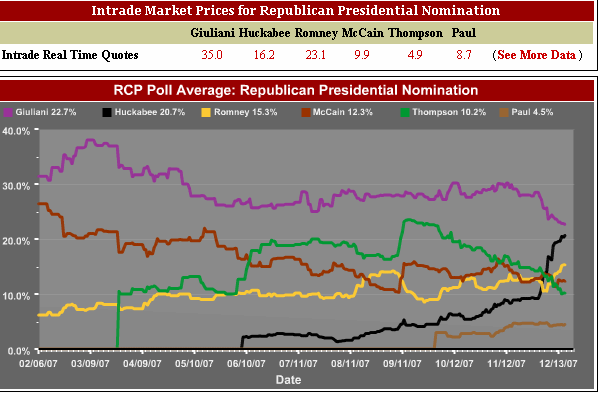
Giuliani looks stronger than he probably is. His problem is that his poll numbers look pretty bad in initial primary states. His appeal to voters nationwide is liable to take a beating if he does poorly in Iowa, New Hampshire, and South Carolina. Jerome’s analysis goes on to mention the enormous fund raising success experienced by Ron Paul. Will that translate into votes? Possibly. But, I see him as this cycle’s Howard Dean — darling of the Internet and able to raise huge amounts of money very quickly, but ultimately not able to translate that support into votes in the real world. Regardless of who comes out on top, it should be a nice dust up. Look at all of the trend lines gathering at about the same level. No front runners. Just a free-for-all. I’d love to see (in either or both primaries) a convention that actually meant something and wasn’t just a scripted coronation.
Update A post by Devilstower at Daily Kos shows just how much use some of these polls and predictions are. In particular, consider a graph of the Iowa Electronic Markets, billed by some as a good predictor of political races, from 2004:
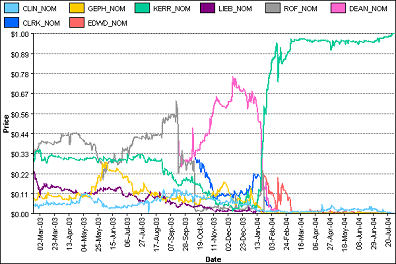
Until the votes in Iowa were counted, Dean was a juggernaut and Kerry was roadkill.
Update 2 The Hoosier Pundit has some observations about the Republican primary from the perspective of a devoted Republican. On Romney and his very conveniently timed conversions on matters of importance to conservatism: His conversions are to be welcomed, but (as one of his opponents memorably put it) I would prefer that they came on the road to Damascus and not the road to Des Moines.
Edwards – Not out of it
David Mizner at MyDD seems to think there are some favorable dynamics at play in the Democratic primary for John Edwards. Edwards is more or less tied in the polls with Clinton and Obama in Iowa. He’s further behind in New Hampshire and elsewhere at the moment, but Mizner argues that the debate in the Democratic primary is headed toward a frame that is quite beneficial to Edwards: who and how to effect change. As Atrios put it:
Obama: The system sucks, but I’m so awesome that it’ll melt away before me.
Edwards: The system sucks, and we’re gonna have to fight like hell to destroy it.
Clinton: The system sucks, and I know how to work within it more than anyone.
Mizner argues that these various approaches flow naturally from the prior history of the candidates. Hillary has been involved with politics her whole life and therefore wants to work within the system. Obama’s background is in community organizing and so he wants to form coalitions. Edwards’ background is in adversarial litigation and so he wants to fight.
For a generation of Democrats who are tired of Democratic leadership that comes off as a bunch of passive, spineless wimps cringing at the feet of their Republican overlords and begging for scraps, the idea of a fighter is appealing. (I know, I know — how can he fight with good hair?). To many of us, that’s what was so appealing about Howard Dean — not his liberal message (which, by the way, if you paid any attention, wasn’t very liberal; unless staying out of Iraq and getting out of Iraq as soon as possible is somehow “liberal”) — but rather the fact that he wasn’t going to back down from a fight. Bipartisanship is fine if both sides are playing the game. But, with a Grover Norquist style of bipartisanship akin to “date rape,” you have to arrange to negotiate from a position of strength. Perhaps if the process had been more adversarial, our information might have been better when Congress was deliberating on whether to authorize the invasion of Iraq.
So, as the saying goes, “interesting . . . if true.” Edwards still has to be considered quite an underdog at this point.
Sen. Meeks has change of heart on gambling
Lesley Stedman Weidenbener, writing for the Louisville Courier Journal has an article entitled “Meeks changes course, favors a casino move.” Apparently Senator Meeks was instrumental in blocking a casino license for Clark County down in southern Indiana. Now he is seeking to have an existing license from the Gary area to Meeks’ own Steuben County. Clark County officials are “curious” about Meeks’ apparent change of heart. With everything else on the table for the session, such legislation is viewed as a long shot.
- « Previous Page
- 1
- …
- 420
- 421
- 422
- 423
- 424
- …
- 689
- Next Page »