The push for Sunday alcohol sales in Indiana continues. The Journal & Courier has an editorial that supports the measure, urging fairness by lifting restrictions on package liquor stores in selling other merchandise at the same time the General Assembly lifts restrictions on selling cold beer at big box stores. They also think any measure should be delayed long enough to give small package stores time to adjust their business models.
Bayh Won’t Run in 2012
What won’t happen in a couple years isn’t, generally speaking, too worthy of comment; but I guess the announcement from Evan Bayh that he won’t run for Governor bears mentioning. To me, this is only significant inasmuch as it affects who actually does end up running. Bayh could have won and – depending who runs – kept someone worse out of the office; but beyond that I don’t think he has much to recommend himself for the job.
I didn’t pay a lot of attention to him prior to his becoming Senator. Mostly what I know is that he used his family name and connections to become Indiana’s Secretary of State, use that as a launching ground to become Governor, and then get into some pissing matches with the state Senate. Speaking of which, I’d be hard pressed to say that former Gov. Bayh was a better influence on Indiana government than his rival at the time, Senator Bob Garton.
But, like I said, I didn’t pay much attention to him as Governor – I was in college for most of that period. I’m sure my luke warm memory of him is colored a great deal by my recollection of him as a Senator. And a great deal of that has to do with my disappointment in him for voting in the Bush tax cuts back in 2001. The federal budget was in pretty good shape back then, and I regarded these tax cuts as wasting a great chance to continue making progress paying down the national debt. At the time, if you’ll recall, the rationale for the cuts was that the government was just bringing in too darn much money. One advocate at the time addressed my concerns about the debt by saying that we ran the risk of paying it down too quickly.
Anyway, Bayh voted for the tax cuts and repealing the estate tax. Since then, I’m at a bit of a loss to say what he got up to during his tenure other than appear on news shows from time to time to make solemn noises about the deficit, so long as there was no threat of imposition on the wealthy or interruption of the flood of money into military expenditures.
I don’t know, maybe I just wasn’t paying attention and have the guy all wrong. But, it’ll be interesting to see what impact this has on his wife’s board member gigs with pharmaceutical and insurance companies and whatnot.
Vouchers
Rumor has it that the Governor is going to take another run at vouchers. One aspect to voucher legislation I would like to see is a provision that allows public schools to reject or eject students based on the same criteria available to private schools. I don’t know if that means restricting the ability of private schools that take vouchers or enhancing the ability of public schools. But, if we’re going to pretend vouchers are good because they create competition, the playing field has to be level. That means not leaving public schools as nothing more than a dumping ground for difficult, expensive to educate students.
On the other hand, if we’re going to stick with the “every kid should have an education” policy choice; then we’re going to have to live with the fact that easy-to-educate kids subsidize the hard-to-educate kids. Vouchers – where we pretend that kids are widgets with associated expenses that are fixed and equivalent – disrupt that subsidy.
Urbanophile on State GDP Performance
There had been some discussion around here a week or two ago about State GDP, so I thought I’d post a link to this recent Urbanophile post that discusses some recent numbers with handy maps.
All is not well most places, really, but because we’re occasionally asked to emulate labor practices of the South because that region is supposedly doing better than the rest of the country, I wanted to note that the South doesn’t appear to be doing notably better than other places and, some parts of the South by some measurements are doing worse:
Some of the fast growing Sun Belt states added people at a faster rate than they grew economic output. Georgia in particular is worth noting, because even metro Atlanta has been showing declining real per capita GDP. In fact, Georgia actually declined by more than Michigan did on this metric, so obviously all is not well down there. Texas, despite its vaunted jobs engine, is expanding almost totally horizontally. It is 9th lowest in the US on real per capita GDP growth, with a nearly flat 2% performance over the last decade.
(emphasis added).
Hoosiers are not financially literate
You know that old political cliche about how individuals know better how to handle their money than the government does? Well, maybe not. How well government manages your money is certainly open to question, but your average Hoosier isn’t really all that well equipped to make decisions about their money.
The Indianapolis Star has an article discussing a nation-wide report by “The Investor Education Foundation of the Financial Industry Regulatory Authority” finding, among other things, that Hoosiers are not, by and large, financially literate. (I think this is a symptom of the larger issue that lots of people are basically innumerate. We need to do a better job of learning our math.)
Results of a nationwide study released Wednesday suggest that residents of Indiana, on the average, are less financially literate than other Americans and that 68 percent of Hoosiers find it hard to pay their bills every month.
. . .
About two-thirds of Hoosiers and most Americans live paycheck to paycheck and don’t have savings for an emergency. A similar number does not bother to comparison shop for the best interest rates and features of credit cards.And 28 percent of Hoosiers have borrowed money from payday lenders and other high-interest-rate sources in recent years, which is higher than the national average of 24 percent.
The article doesn’t do a very good job of explaining whether some of these factors are a function of people not knowing any better versus not having any other realistic options. But, from personal experience collecting debts, it’s a little amazing how many people just have no clue about the concept of interest. (My standard explanation is that you’d rather have $100 today than $100 in ten years, and interest is designed to compensate you for having to wait.
The study is here. I haven’t looked at it yet.
Tax Cuts for the Rich & UI Benefits
I had been relatively sanguine about deficit spending because I anticipated: a) an economic recovery; and b) expiration of the ill-advised Bush tax cuts. Obviously I’m an idiot. Obama and the GOP have struck a deal whereby the tax cuts would be extended and Congress would allow for an additional 13 months of unemployment benefits. They’re calling these things “temporary;” Mr. Obama says that *next time* he’ll fight extension of tax cuts for the rich, but we’re in Lucy-with-the-football territory here. That’s not going to happen.
If Mr. Obama thinks I’m being sanctimonious by calling this a horrible idea, then, with respect, bite me Mr. President. Call their bluff. See if they’re really willing to raise taxes on huge majorities to protect the interests of the wealthy. Push a new tax plan, maybe get credit for your own tax cuts. As it is, Bush continues to get credit for tax cuts, Obama gets blamed for the deficit.
I suppose I am insufficiently compassionate for the unemployed and for millionaires, but my suspicion is that my economic prospects would be better if I lost whatever tax benefits I receive under the Bush versus the Clinton era tax structure and, in return, the money lost on this deal was available to reduce the deficit, pay down the debt, or other purposes. At least the Depression era public works projects gave us tangible infrastructure we still use today. To me, this just looks like another squeeze on the middle class for the benefit of the rich and the poor.
Social Security Is Not the Problem (Continued)
Mike Kole posted a Reuters chart that ties into my recent post about Social Security not being the problem.
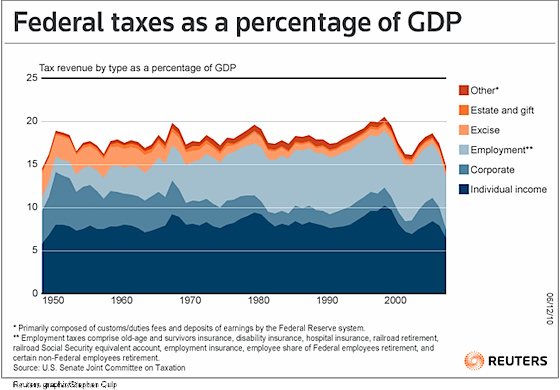
Mike had a different point to make about how we should cut spending; but I think this graph says a lot about how funding of government expenditures has changed over the past 50 years. Note the sharp decrease in the share of federal revenues represented by corporate and estate taxes. Income taxes have dropped some but not in the same proportion as corporate and estate taxes. And those payroll taxes (social security and comparable taxes) have really been asked to pick up the slack. Given that those taxes are only on the first $107,000 or so of income, if there is class warfare in this country, it’s reasonably clear who has been winning in post-World War II America.
Also, keep this post in mind the next time someone uses payment of federal income tax as a sort of stand-in for a person’s overall tax burden while advancing the argument that the rich are over taxed and the non-rich aren’t doing their fair share.
Social Security Isn’t The Problem
Matt Taibbi makes a point that I made 5 or 6 years ago. (And I’m sure it wasn’t original to me.) Social Security isn’t the problem. Thanks to an increase in the regressive payroll taxes back in the 80s, Social Security has been solvent. The problem has been the raiding of that regressive tax money to pay for things like tax cuts for millionaires and ill-advised wars.
Let’s be clear about what’s going on here. Social Security was never the cause of the nation’s debt problems. This issue dates all the way back to the Eighties, when Ronald Reagan hired Alan Greenspan to chair the National Commission on Social Security Reform, ostensibly to deal with a looming shortfall in the fund. Greenspan’s solution was to hike Social Security tax rates (they went from 9.35% in 1981 to 15.3% in 1990) and build up a “surplus” that could be used to pay Baby Boomers their social security checks 30 years down the road.
They raised the SS taxes all right, but they didn’t save the money for any old Baby Boomers in the 2000s. Instead, Reagan blew that money paying for eight years of deficit spending and tax cuts. Three presidents after him used the same trick. They used about $1.69 trillion in extra Social Security revenue (from the Greenspan hikes) to pay for current-day goodies, with the still-being-debated Bush tax cuts being a great example. This led to the infamous moment during Bush’s presidency when Paul O’Neill announced that the Social Security Trust Fund had no assets.
Well, duh! That is what happens to a fund, when you spend 30 years robbing it to pay for tax cuts for Jamie Dimon and Lloyd Blankfein. It will tend to get empty. But of course this wasn’t presented to the public as being the consequence of too many handouts to wealthy campaign contributors: this was presented as a problem of those needy goddamned old people wanting to retire too early and being just far too greedy when it came to actually wanting their Social Security benefits paid out.
R.I.P. Sen. Joe Harrison
The Journal & Courier is reporting that Sen. Joe Harrison died on Thursday, Dec. 2, 2010 at the age of 79. (h/t Tipsy Teetotaler). (Longer article here.) At 40 years in 2006 when he retired, Harrison was Indiana’s longest serving state Senator. My understanding is that he was part of a group of four state senators who dominated that chamber for a good long time – him, Morris Mills, Bob Garton, and Larry Borst.
He headed up the Senate’s labor committee where labor laws passed by the House usually went to die. He was also the Senator who offered the most resistance to the in-house printing project at Legislative Services back in the late 90s when I was there. (He was reluctant to take printing of the bills out of the hands of the private contractor who had been doing the work.) He was also tied into the Harrison Steel company in Attica.
That’s most of what I know about Sen. Harrison. There is no doubt that he was a major force in Indiana politics over most of the last half century. Rest in Peace, Senator.
Secession was about slavery and not about a limited federal government
We’re hot on the heels of the 150th anniversary of the secession of South “First in Treason” Carolina: December 20, 1860. You’ll hear a lot of apologists try to pretend that the Civil War was not about slavery. It was about federalism and limited government. This is demonstrably false. South Carolina was kind enough to follow the lead of Thomas Jefferson and state the reasons for taking up arms against the United States of America.
South Carolina was upset that the Northern States had been less than faithful in executing the Fugitive Slave Act – the law that said non-slave states had to help recover slaves who ran away. Got it? South Carolina was upset that states weren’t submitting to federal law. No state’s rights there. No limited government. They were upset that non-slave states weren’t helping them to preserve slavery.
The same article of the Constitution stipulates also for rendition by the several States of fugitives from justice from the other States.
The General Government, as the common agent, passed laws to carry into effect these stipulations of the States. For many years these laws were executed. But an increasing hostility on the part of the non-slaveholding States to the institution of slavery, has led to a disregard of their obligations, and the laws of the General Government have ceased to effect the objects of the Constitution. The States of Maine, New Hampshire, Vermont, Massachusetts, Connecticut, Rhode Island, New York, Pennsylvania, Illinois, Indiana, Michigan, Wisconsin and Iowa, have enacted laws which either nullify the Acts of Congress or render useless any attempt to execute them. In many of these States the fugitive is discharged from service or labor claimed, and in none of them has the State Government complied with the stipulation made in the Constitution. The State of New Jersey, at an early day, passed a law in conformity with her constitutional obligation; but the current of anti-slavery feeling has led her more recently to enact laws which render inoperative the remedies provided by her own law and by the laws of Congress. In the State of New York even the right of transit for a slave has been denied by her tribunals; and the States of Ohio and Iowa have refused to surrender to justice fugitives charged with murder, and with inciting servile insurrection in the State of Virginia.
Secession was absolutely about slavery and anyone who says otherwise is lying or willfully ignorant.
- « Previous Page
- 1
- …
- 208
- 209
- 210
- 211
- 212
- …
- 689
- Next Page »